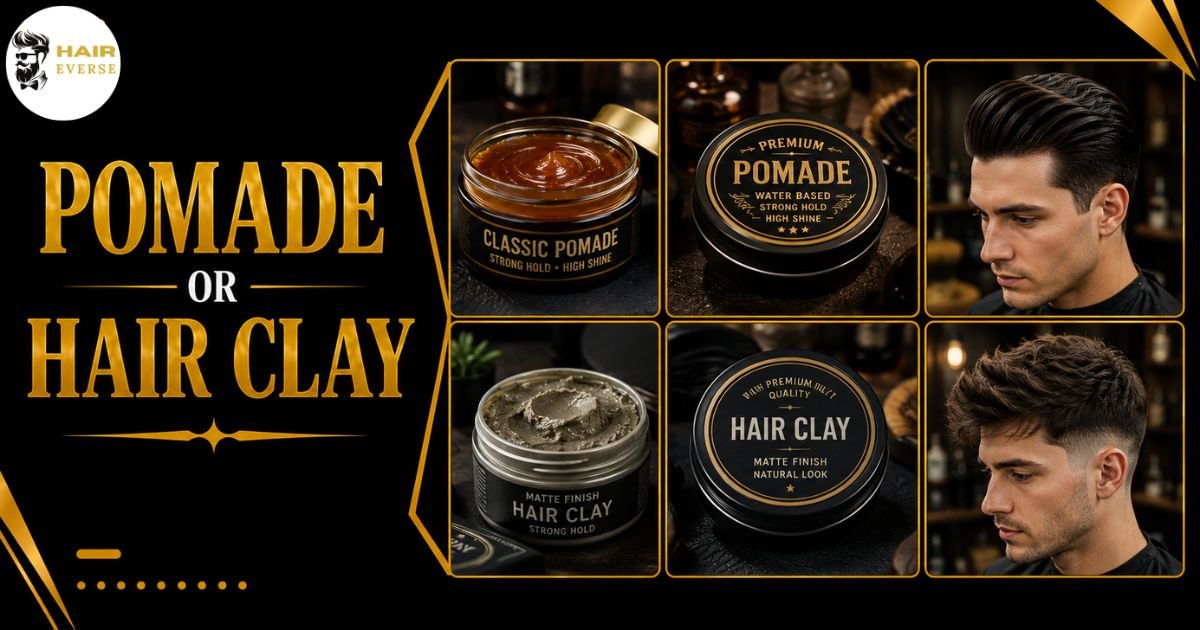
Pomade or Hair Clay: Which One Do You Need?
Standing at the bathroom mirror with two jars and no idea which one actually belongs in your hair is a familiar problem. The pomade or hair clay debate trips up a lot of guys because both products promise hold, but they deliver completely different finishes, and using the wrong one leaves your hair either greasy by noon or flat by lunch.
Barbers see this mismatch constantly: a client with fine hair using a heavy pomade, wondering why his style collapses by early afternoon. This guide breaks the choice down into 35 real hair-type-and-goal scenarios, so you can match your exact situation instead of guessing at the shelf.
Quick Comparison Table for Using Pomade or Hair Clay
Here a comaprison table for using Pomade or Hairclay; How to use and Which one’s good for you’re hairs.
| Product | Finish | Hold Style | Best Hair Types | Washout |
| Hair Clay | Matte, textured | Grips individual strands | Fine, thick, curly, wavy | Easy, single wash |
| Water-Based Pomade | Low to medium shine | Smooth, directional | Straight, wavy, medium-thick | Easy, single wash |
| Oil-Based Pomade | High shine, wet look | Strong, all-day | Thick, coarse, straight | Difficult, needs clarifying shampoo |
What’s the Difference Between Pomade and Hair Clay?
Pomade and hair clay solve the same basic problem, holding your hair in place, using opposite methods. Pomade coats the hair shaft to create a smooth, directional finish with real shine, ranging from a subtle sheen in water-based formulas to a full wet look in oil-based ones. Hair clay uses mineral ingredients, usually bentonite or kaolin, that grip individual strands and absorb excess oil, producing a matte, textured hold with no shine at all.
The practical difference shows up the moment you touch your hair. Clay feels dry and grippy. Pomade feels smooth and slightly slick. Neither is a universal upgrade over the other; they’re built for different hair textures and different finished looks.
Is Hair Clay Better Than Pomade?
Neither product is objectively better. Hair clay tends to outperform pomade for fine, thick, curly, or wavy hair that needs texture and volume without shine. Pomade tends to win for straight or medium-thick hair aiming for a smooth, classic, directional style like a side part or slick back. The right answer depends entirely on your hair type and the finish you’re after, which is exactly what the 35 scenarios below are built to clarify.
Fine and Thin Hair
- Fine Hair, Wants Volume
- Fine Hair, Wants a Slick Side Part
- Fine Hair, Oily by Midday
- Fine Hair, Humid Climate
- Fine Hair, Professional Office Look
- Fine Hair, Everyday Low-Effort Style
Fine Hair, Wants Volume
Overview: Fine hair often looks flat by midday because there’s nothing to grip onto once it’s combed into place.
Recommendation: Hair clay. The mineral base adds friction to each strand, creating the illusion of thickness without weighing hair down.
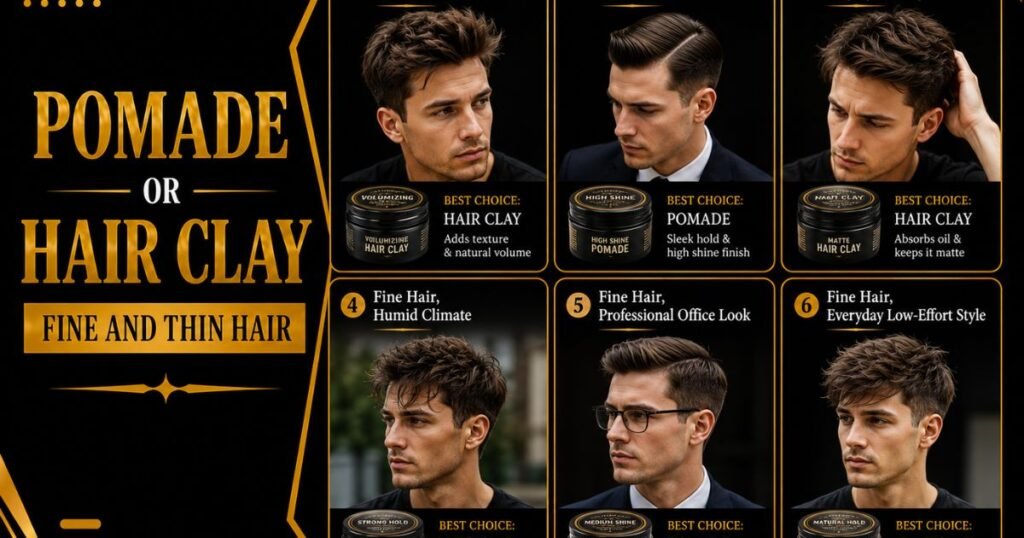
How To Apply This: Use a pea-sized amount on towel-dried hair and work from the roots outward for lift.
Pro Tip: Less is more here too much clay on fine hair can make it look chalky rather than fuller.
Fine Hair, Wants a Slick Side Part
Overview: A classic side part on fine hair needs smoothness without heaviness, which rules out oil-based pomade.
Recommendation: A light water-based pomade. It gives directional control and shine without the weight that flattens fine strands.
How To Apply This: Apply a dime-sized amount to dry hair and comb through in one direction.
Pro Tip: Skip damp application here extra moisture plus pomade is the combination most likely to make fine hair go flat.
Fine Hair, Oily by Midday
Overview: Fine hair often shows scalp oil more visibly than thicker textures, making shine an unwanted side effect by afternoon.
Recommendation: Hair clay, which actively absorbs excess oil at the scalp rather than adding to the shine.
How To Apply This: Apply to freshly washed, towel-dried hair rather than day-old hair for the best oil control.
Pro Tip: Pomade will visibly amplify midday oil on fine hair clay is the safer everyday choice for this exact problem.
Fine Hair, Humid Climate
Overview: Fine hair loses shape fastest in humidity because there’s little natural body to resist moisture in the air.
Recommendation: Hair clay, since its mineral grip resists humidity better than a smooth pomade coating does.
How To Apply This: Build hold gradually with two light applications rather than one heavy one for longer-lasting grip.
Pro Tip: A stronger-hold clay formula is worth the upgrade if you live somewhere humid most of the year.
Fine Hair, Professional Office Look
Overview: A polished office look on fine hair calls for control without the flat, weighed-down look heavier products cause.
Recommendation: A light water-based pomade applied sparingly, which smooths without collapsing volume entirely.
How To Apply This: Apply to dry hair and comb through gently rather than pressing the product flat against the scalp.
Pro Tip: Pair with a quick blow-dry lift at the roots before applying for a fuller finish that still reads as polished.
Fine Hair, Everyday Low-Effort Style
Overview: Most guys with fine hair want a fast, no-fuss routine that still looks intentional.
Recommendation: Hair clay applied with fingers only, no comb required, for a quick textured finish.
How To Apply This: Warm a small amount between palms and scrunch through damp or towel-dried hair for 30 seconds.
Pro Tip: This is the fastest routine on this list genuinely under a minute once you’re used to the amount needed.
Thick and Coarse Hair
- Thick Hair, Wants Control
- Thick Hair, Textured Crop
- Thick Hair, Pompadour
- Thick Hair, Matte Separation
- Thick Hair, Unruly and Frizzy
- Thick Hair, Active or Gym Use
Thick Hair, Wants Control
Overview: Thick, coarse hair naturally resists styling, which is exactly the problem a strong pomade is built to solve.
Recommendation: Oil-based or strong water-based pomade for maximum directional control.
How To Apply This: Apply to fully dry hair and work in sections to ensure even coverage through the density.
Pro Tip: Thick hair can handle more product than fine hair, don’t be shy with the amount.
Thick Hair, Textured Crop
Overview: A textured crop on thick hair needs separation and grip, not smoothness.
Recommendation: Hair clay, which creates defined, separated pieces rather than a single controlled mass.
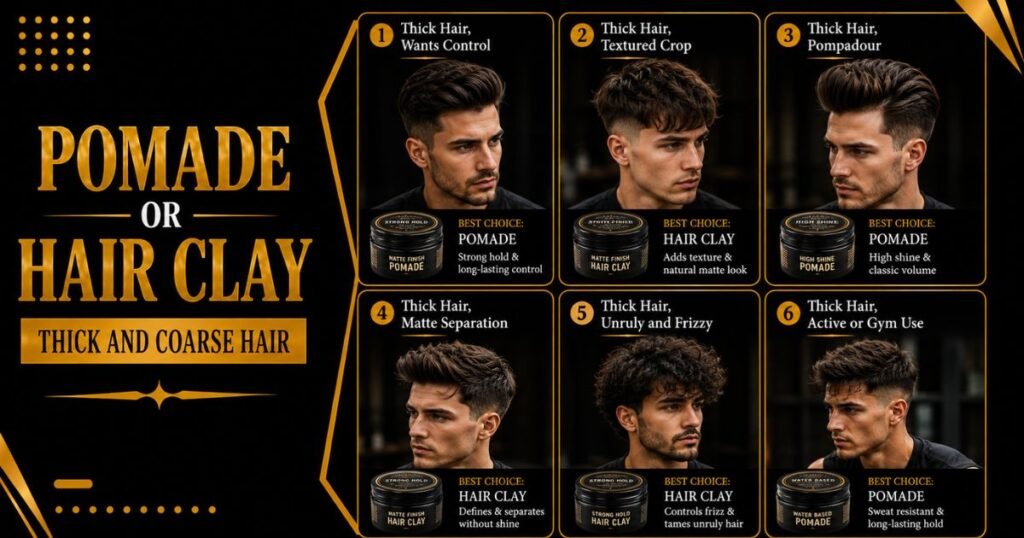
How To Apply This: Apply to towel-dried hair and use fingertips to pull individual sections into place.
Pro Tip: Avoid combing after application fingers preserve the separated texture a comb would flatten.
Thick Hair, Pompadour
Overview: A proper pompadour needs height, direction, and shine, all of which favor pomade over clay.
Recommendation: A strong-hold oil-based pomade for all-day height retention.
How To Apply This: Blow-dry hair upward first, then apply pomade to dry hair and comb the front section into shape.
Pro Tip: Build the shape while the pomade is still slightly warm from your palms it moves more easily.
Thick Hair, Matte Separation
Overview: Some thick-haired guys want strand separation and hold without any shine at all.
Recommendation: A heavy-hold hair clay formulated specifically for coarse, resistant hair textures.
How To Apply This: Apply generously to towel-dried hair and work through thoroughly before shaping.
Pro Tip: Lighter clays often underperform on thick hair this is the one scenario where a heavier formula genuinely helps.
Thick Hair, Unruly and Frizzy
Overview: Thick hair that’s also frizzy often resists a single product entirely.
Recommendation: Layer pomade as a base on damp hair, then finish with clay once dry for texture and control.
How To Apply This: Apply pomade first to calm the surface, blow-dry, then work clay through for the final shape.
Pro Tip: Never reverse the order clay applied first blocks the pomade from smoothing the surface properly.
Thick Hair, Active or Gym Use
Image Search Keyword: “hair clay gym active thick hair” Filename: hair-clay-gym-active.jpg Alt Text: Man with thick hair styled with sweat-resistant hair clay for gym use
Overview: Thick hair under physical activity needs a product that resists sweat without turning greasy.
Recommendation: Hair clay, since its matte, oil-absorbing nature holds up better under sweat than pomade’s smoother coating.
How To Apply This: Apply a slightly heavier amount than usual before activity for longer-lasting grip.
Pro Tip: Keep a travel-size clay in your gym bag for a quick reapplication after a shower.
Straight Hair
- Straight Hair, Slick Back
- Straight Hair, Textured Spike
- Straight Hair, Comb Over
- Straight Hair, Natural Texture
- Straight Hair, All-Day Shine
Straight Hair, Slick Back
Overview: Straight hair naturally lies flat, making it the ideal candidate for pomade’s smoothing effect.
Recommendation: Water-based or oil-based pomade, depending on how much shine you want.
How To Apply This: Apply to dry hair, comb straight back, and finish with a fine-tooth comb for a clean surface.
Pro Tip: Straight hair takes pomade more evenly than any other hair type, so a little goes further here.
Straight Hair, Textured Spike
Overview: Naturally smooth straight hair lacks texture on its own, so clay has to build it artificially.
Recommendation: Hair clay, applied to create deliberate texture and separation straight hair doesn’t provide naturally.
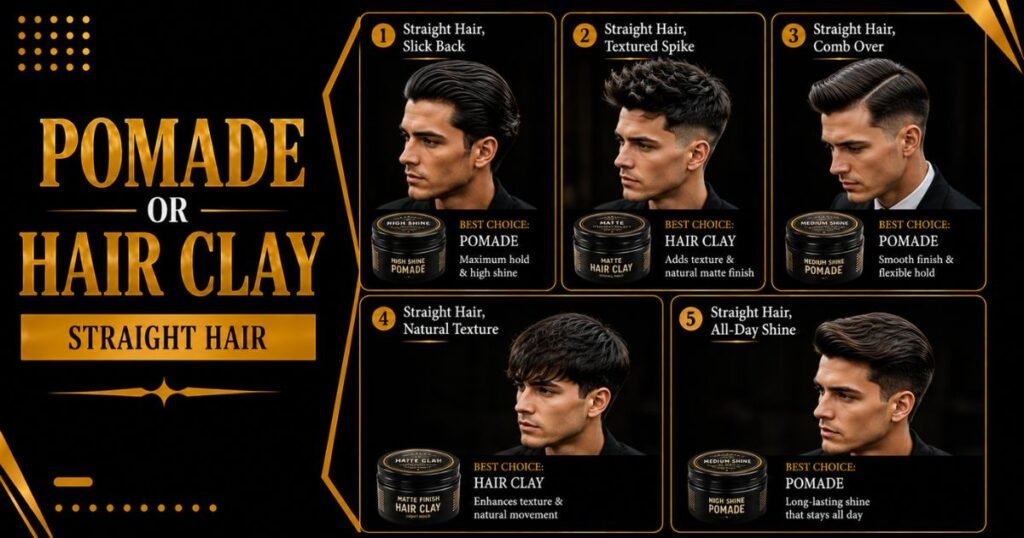
How To Apply This: Apply to dry hair and pinch small sections upward with fingertips to build height.
Pro Tip: Straight hair holds clay-built texture longer than curlier types, since there’s less natural movement fighting the shape.
Straight Hair, Comb Over
Overview: A comb over depends on the hair moving as a single, controlled unit, which is pomade’s specialty.
Recommendation: A medium-hold pomade for smooth, directional control that lasts through the day.
How To Apply This: Apply to dry hair, establish your part, then comb the longer side over cleanly.
Pro Tip: Water-based pomade lets you refresh the part later in the day with a damp comb, no reapplication needed.
Straight Hair, Natural Texture
Overview: Some straight-haired guys want subtle texture without a fully styled, combed look.
Recommendation: A light-hold clay applied minimally for definition without stiffness.
How To Apply This: Apply a small amount to dry hair and tousle briefly with fingers, skipping the comb entirely.
Pro Tip: Straight hair needs less clay than any other type to achieve visible texture start smaller than you think.
Straight Hair, All-Day Shine
Overview: For a classic, high-shine finish that holds from morning to night, straight hair is the easiest texture to work with.
Recommendation: Oil-based pomade, which delivers the strongest, longest-lasting shine of any option.
How To Apply This: Apply to fully dry hair, working section by section for even gloss.
Pro Tip: Plan on a clarifying shampoo every few washes to prevent buildup from daily oil-based use.
Wavy Hair
- Wavy Hair, Enhancing Natural Waves
- Wavy Hair, Wants a Smoother Look
- Wavy Hair, Brush Back Style
- Wavy Hair, Humidity Frizz Control
- Wavy Hair, Polished Quiff
Wavy Hair, Enhancing Natural Waves
Overview: Wavy hair often looks best when the product works with its natural movement rather than against it.
Recommendation: Hair clay, applied lightly to hold the wave pattern without flattening it.
How To Apply This: Apply to damp hair and scrunch upward gently to encourage the natural wave shape.
Pro Tip: Air-drying partially before applying clay preserves more natural waves than a full blow-dry first.
Wavy Hair, Wants a Smoother Look
Overview: Some wavy-haired guys prefer to tone down the wave for a more refined, controlled look.
Recommendation: A water-based pomade that smooths without fully flattening the underlying texture.
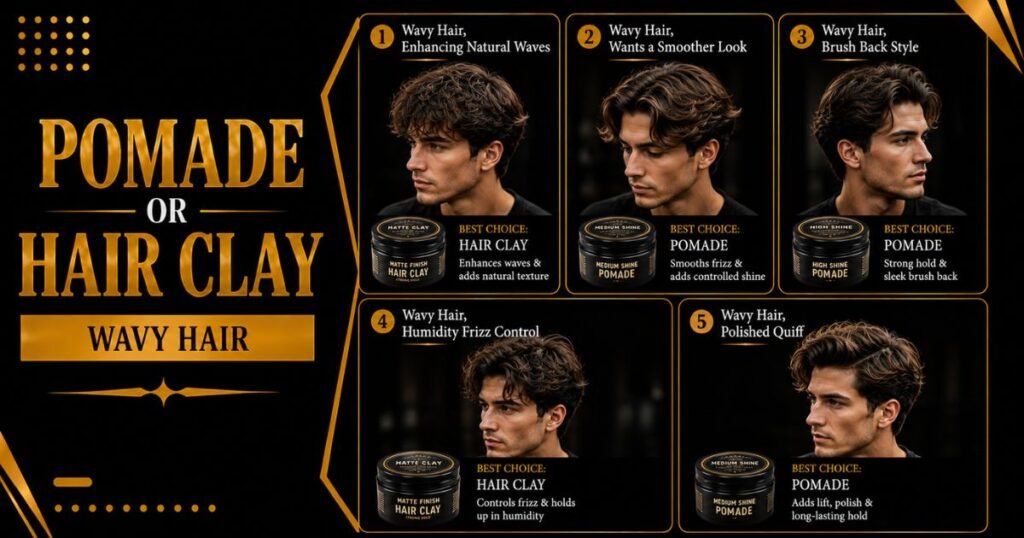
How To Apply This: Apply to slightly damp hair and comb through firmly to reduce visible wave.
Pro Tip: Full smoothness on wavy hair may require a quick blow-dry with a brush before the pomade goes in.
Wavy Hair, Brush Back Style
Overview: A brush back on wavy hair benefits from both grip and a bit of surface polish.
Recommendation: Layer a light clay base with a small amount of pomade on top for texture plus sheen.
How To Apply This: Work clay through towel-dried hair first, then smooth a small amount of pomade over the surface.
Pro Tip: Brush upward and back in one motion once both products are in for the cleanest line.
Wavy Hair, Humidity Frizz Control
Overview: Wavy hair tends to frizz in humid weather more than straight hair, disrupting the intended shape.
Recommendation: Hair clay, which resists humidity-driven frizz better than a smooth pomade coating.
How To Apply This: Apply to damp hair before it fully air-dries to lock the shape in as it sets.
Pro Tip: A slightly heavier hand on humid days helps the style hold through the afternoon.
Wavy Hair, Polished Quiff
Overview: A polished quiff on wavy hair needs enough control to keep the shape structured through the day.
Recommendation: A medium-hold pomade applied after a directional blow-dry for a smooth, lifted finish.
How To Apply This: Blow-dry hair upward and back first, then apply pomade to dry hair and shape with a comb.
Pro Tip: Wavy hair holds a quiff shape longer with pomade than clay, since the smooth coating resists the wave relaxing the style.
Curly Hair
- Curly Hair, Defining Individual Curls
- Curly Hair, Avoiding a Greasy Look
- Curly Hair, Loose Curl Separation
- Curly Hair, Managing Shrinkage and Volume
- Curly Hair, Special Event Slick Look
Curly Hair, Defining Individual Curls
Overview: Curly hair needs a product that separates and defines each curl without weighing it down.
Recommendation: Hair clay, which grips individual curls and holds their shape without added grease.
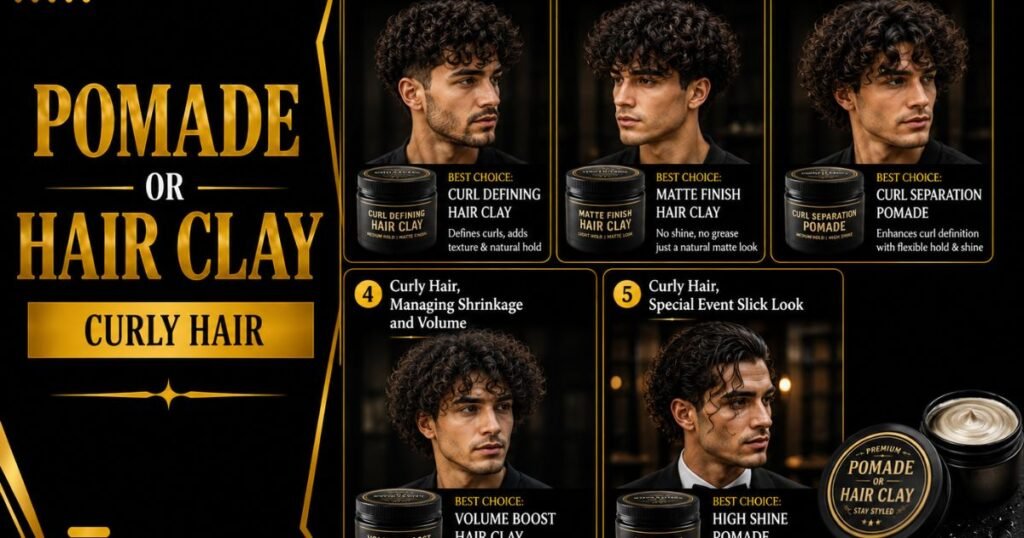
How To Apply This: Apply to damp hair and scrunch upward, letting curls dry naturally into place.
Pro Tip: Avoid combing after application; it disrupts curl clumping and creates frizz instead of definition.
Curly Hair, Avoiding a Greasy Look
Overview: Pomade, especially oil-based, tends to make curls look coated and heavy rather than defined.
Recommendation: Hair clay over pomade for curly hair almost every time, thanks to its matte, natural finish.
How To Apply This: Use a light amount on damp hair so curls stay bouncy rather than weighed down.
Pro Tip: If you already own pomade, save it for straighter hair types and keep clay as your curly-hair go-to.
Curly Hair, Loose Curl Separation
Overview: Looser curl patterns sometimes need just enough product to separate strands without overdefining them.
Recommendation: A light-hold clay applied sparingly for a natural, barely-there separation.
How To Apply This: Rub a small amount between palms and lightly scrunch through damp curls.
Pro Tip: Less product here reads as more natural loose curls rarely need a heavy hand.
Curly Hair, Managing Shrinkage and Volume
Overview: Curly hair often shrinks as it dries, and the right product can help maintain length and shape.
Recommendation: Hair clay applied while hair is still damp, before shrinkage fully sets in.
How To Apply This: Apply immediately after washing, while hair is still wet, and let it air-dry undisturbed.
Pro Tip: Diffusing on low heat after applying clay can help preserve more length than air-drying alone.
Curly Hair, Special Event Slick Look
Overview: For a rare occasion calling for a slicker look, curly hair can take a small amount of pomade carefully.
Recommendation: A very light water-based pomade, used sparingly and only for occasional smoother styles.
How To Apply This: Apply a small amount to damp hair and comb gently, checking frequently to avoid overloading curls.
Pro Tip: Keep this as an occasional option rather than a daily routine clay remains the better everyday choice for curls.
General Goals and Situations
- Wants a Completely Matte, No-Shine Finish
- Wants a High-Shine Classic Look
- Wants a Reworkable All-Day Style
- Wants the Easiest Possible Washout
- Wants Long-Lasting Hold in Heat
- First-Time Buyer, Not Sure Where to Start
- Wants Both Texture and Shine
- Wants One Product for Everything, On a Budget
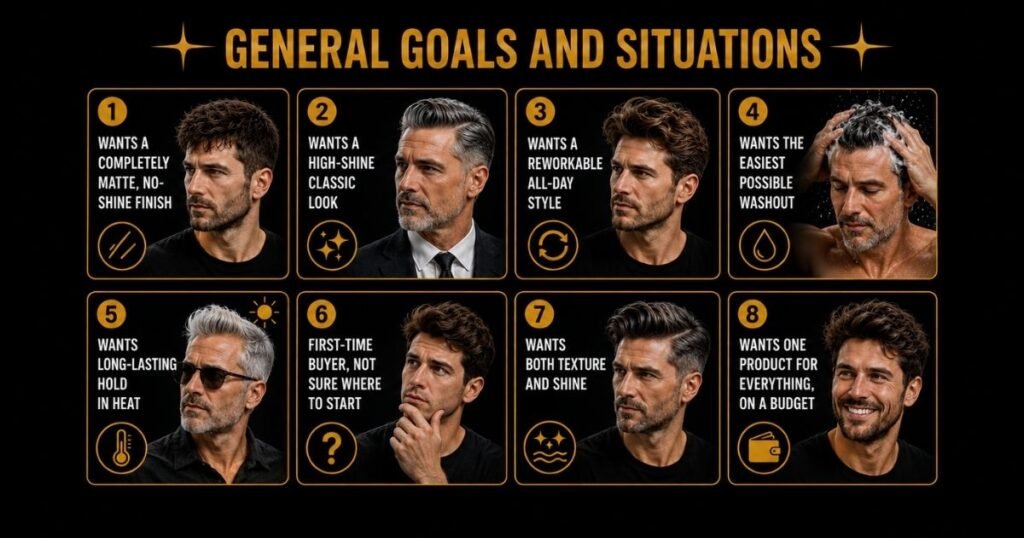
Wants a Completely Matte, No-Shine Finish
Overview: Some guys want it to look like they used nothing at all, just naturally great hair.
Recommendation: Hair clay is the clear choice here, across nearly every hair type.
How To Apply This: Apply lightly and blend thoroughly so no visible product clumps remain.
Pro Tip: If your hair still looks shiny after clay, you’re likely using too much scale back before switching products.
Wants a High-Shine Classic Look
Overview: For an authentic vintage-inspired style, shine isn’t a side effect, it’s the entire point.
Recommendation: Oil-based pomade delivers the strongest, most authentic high-shine finish available.
How To Apply This: Apply to fully dry hair and comb thoroughly for an even, glossy surface.
Pro Tip: This finish looks best paired with a classic cut like a pompadour or slick back rather than a modern crop.
Wants a Reworkable All-Day Style
Overview: Some guys need to reshape their hair partway through the day, after a hat, a workout, or a long meeting.
Recommendation: Water-based pomade, which reactivates with a little water or damp fingers.
How To Apply This: Run damp fingertips through your hair and reshape as needed, no extra product required.
Pro Tip: Keep a small travel container of water-based pomade at your desk for quick midday touch-ups.
Wants the Easiest Possible Washout
Overview: Some guys simply want a product that disappears completely at the end of the day with minimal effort.
Recommendation: Hair clay rinses out with a single regular shampoo wash in almost every case.
How To Apply This: Wash as you normally would; no clarifying shampoo or extra rinse cycles are needed.
Pro Tip: If you’re currently on oil-based pomade and dread wash day, switching to clay solves that specific frustration.
Wants Long-Lasting Hold in Heat
Overview: Heat and sweat break down a lot of styling products faster than users expect.
Recommendation: Hair clay generally holds up better than pomade in hot, sweaty conditions.
How To Apply This: Apply a slightly heavier amount than usual before a full day outdoors.
Pro Tip: Oil-based pomade can turn tacky in heat, while clay tends to stay grippy rather than greasy.
First-Time Buyer, Not Sure Where to Start
Overview: If you’ve never used either product, the safest starting point is the one with the fewest ways to go wrong.
Recommendation: A medium-hold hair clay is the most forgiving first purchase for most hair types and goals.
How To Apply This: Start with a pea-sized amount and add more only if the first application feels underwhelming.
Pro Tip: Once you know your hair’s response to clay, you’ll have a much easier time deciding if pomade is worth adding too.
Wants Both Texture and Shine
Overview: Some styles genuinely need both qualities at once, texture from clay and a hint of polish from pomade.
Recommendation: Layer clay first as a base, then a small amount of pomade on top to add controlled sheen.
How To Apply This: Work clay through towel-dried hair completely before adding a light layer of pomade on the surface only.
Pro Tip: Never apply pomade first; it seals the hair and prevents clay from gripping properly afterward.
Wants One Product for Everything, On a Budget
Overview: Not everyone wants to buy and manage two separate products just for daily styling.
Recommendation: A matte, water-based pomade sits closest to the middle ground between clay’s texture and pomade’s control.
How To Apply This: Apply to dry hair as you would a light pomade, adjusting the amount based on desired hold.
Pro Tip: This is a genuine compromise, not a perfect substitute for either product at its best expect slightly less texture than pure clay and slightly less shine than a true pomade.
Can You Use Pomade and Hair Clay Together?
Yes, and for several hair types it’s the best of both worlds. The standard approach is clay first, applied to towel-dried or damp hair as your base for grip and volume, followed by a small amount of pomade smoothed over the surface once your hair is dry for a touch of controlled shine. Reversing the order rarely works well, since pomade coats and smooths the hair shaft in a way that stops clay from gripping properly afterward.
What Lasts Longer in Humidity, Pomade or Hair Clay?
Hair clay generally holds up better in humid conditions. Its mineral base absorbs moisture and excess oil rather than reacting to it, while pomade’s smooth coating can soften and lose hold as humidity rises throughout the day. If you live somewhere consistently humid, clay is usually the safer everyday choice regardless of your hair type.
How to Apply Each Product
Applying Hair Clay:
- Start with towel-dried or fully dry hair rather than soaking wet strands.
- Take a pea-sized amount and warm it between your palms until pliable.
- Work through hair from back to front for even distribution.
- Shape with fingers for texture, or a comb for more defined lines.
- Add more gradually if needed rather than overloading from the start.
Applying Pomade:
- Water-based pomade works on damp or dry hair; oil-based performs best on fully dry hair.
- Warm a small amount between your palms first.
- Apply section by section for even coverage.
- Comb or brush in the direction of your intended style.
- Reactivate water-based pomade later in the day with a little water if needed.
Product Recommendations
Hair Cream
- Best For: A soft, natural hold with minimal shine on straight to wavy hair.
- How To Use: Warm between palms and work through damp hair for a lightweight finish.
Pomade
- Best For: Classic, directional styles like slick backs and side parts.
- How To Use: Apply to dry hair and comb in your intended direction for a smooth, controlled result.
Wax
- Best For: Flexible, reworkable hold with a natural sheen on curly or wavy hair.
- How To Use: Rub between fingertips to soften before working through dry hair section by section.
Clay
- Best For: Matte, textured hold across fine, thick, curly, and wavy hair types.
- How To Use: Apply to towel-dried hair and shape with fingers for definition without shine.
Shampoo
- Best For: Removing product buildup, especially after regular oil-based pomade use.
- How To Use: Use a clarifying formula weekly if you style daily with heavier products.
Conditioner
- Best For: Keeping curly or coarse hair manageable before styling products goes in.
- How To Use: Apply after shampoo and rinse thoroughly to avoid weighing hair down before styling.
Maintenance and styling times are estimates and may vary by hair type.
Want Perfact Hairstyles ans Their Product Recommensation?
Beard fade styles have become a go-to choice in 2026 for men who want a sharp, well-defined jawline without a heavy, blocky beard look. This guide rounds up modern beard fade styles from subtle, close tapers to bold skin fades that blend seamlessly into the hairline. Whatever your beard thickness or face shape, you’ll find a variation here to sharpen your overall look.
The right beard and haircut combo can completely transform your look, balancing your face shape and complementing your age for a sharper, more put-together style. This guide breaks down the best beard and haircut combo pairings from clean fades with tapered beards to textured tops with fuller, well-groomed facial hair. Whatever your face shape or stage of life, you’ll find a combination here that works for you.
Fade haircuts for Black men remain one of the most versatile styles in 2026, valued for their clean lines and ability to work with any texture, from tight coils to loose curls. This guide rounds up 75 fade haircuts for Black men, from classic low and high fades to bold designs and taper combinations paired with waves, afros, or braids. Whatever your style or maintenance level, you’ll find a cut here worth trying.
Want classy look haircuts then go for: The Ivy League haircut pairs short, tapered sides with more length on top for a neat, versatile look that’s easy to style. Once known for its preppy campus roots, it now comes with modern fades, textured tops, and tousled finishes for a fresher take. This guide rounds up 30 modern Ivy League haircut styles to help you find the right version for a sharp, put-together look.
Also Side part haircuts for men remain a timeless choice in 2026, prized for their clean, polished look that works for both formal and casual settings. This guide rounds up 35 trending side part haircuts for men from sleek classic finishes to textured, faded modern takes. Whatever your hair type or style preference, you’ll find a variation here worth trying.
Final Thoughts
The pomade vs hair clay decision isn’t about which product is objectively better, it’s about matching the right tool to your hair type and the finish you actually want. If you take nothing else from this guide, remember the core split: clay for matte, textured, natural results, and pomade for shine, smoothness, and classic control.
Give yourself permission to experiment, especially with layering the two together if your hair type calls for it. Most guys land on their ideal routine after trying two or three combinations from these 35 scenarios, not their very first purchase. If you’re ready to go deeper on application technique, our guide on applying hair clay the right way is a natural next step.
FAQs
Which is better for thin pomade or hair clay?
Hair clay is generally better for thin hair. Its mineral base adds texture and the illusion of thickness, while pomade tends to smooth fine strands flat and can make them look thinner by comparison.
Does hair clay wash out easily?
Yes. Most hair clay formulas rinse out cleanly with a single regular shampoo wash, since they don’t contain the heavier oils or waxes found in traditional pomade.
What’s the difference between oil-based and water-based pomade?
Oil-based pomade gives stronger, longer-lasting shine but is harder to wash out, often needing a clarifying shampoo. Water-based pomade is easier to rinse clean and can be reactivated with water throughout the day.
Is pomade or hair clay better for curly hair?
Hair clay is usually the better choice for curly hair. It defines and separates curls without the greasy, weighed-down look pomade can create, especially oil-based formulas.
Does hair clay damage your hair?
No, hair clay does not damage hair when used correctly. Most formulas use natural ingredients and rinse out cleanly, though over-applying can lead to buildup if it isn’t washed out thoroughly.